Article Database
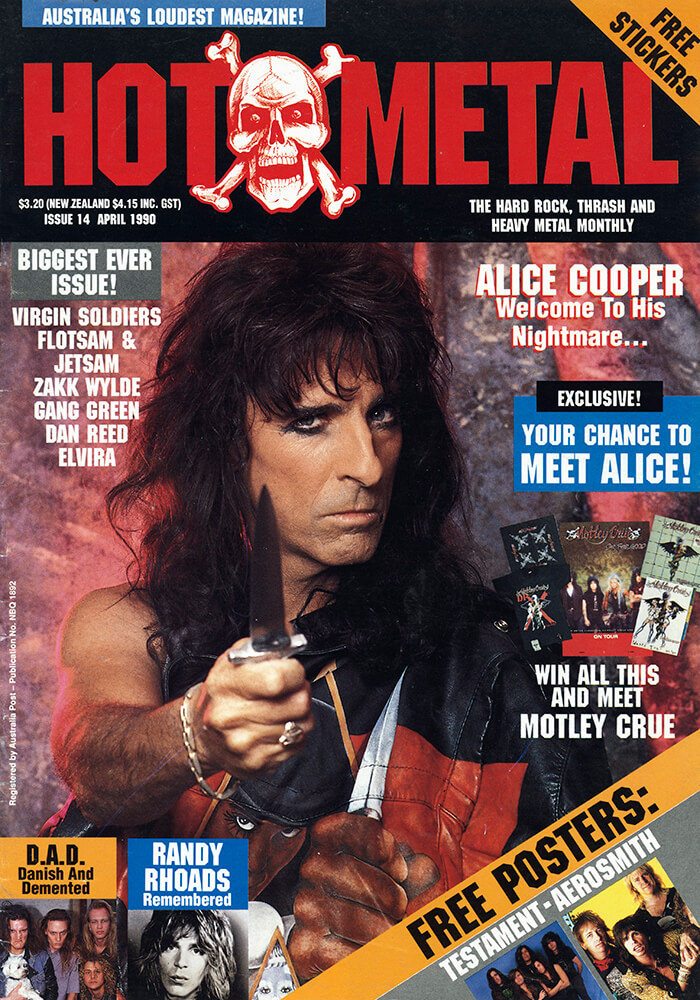
Hot Metal
April 1990
The Twilight World of Alice Cooper
As Trash takes off in a very major way, Ian McFarlane talks to Alice Cooper about his truly legendary career.
Author: Ian McFarlane
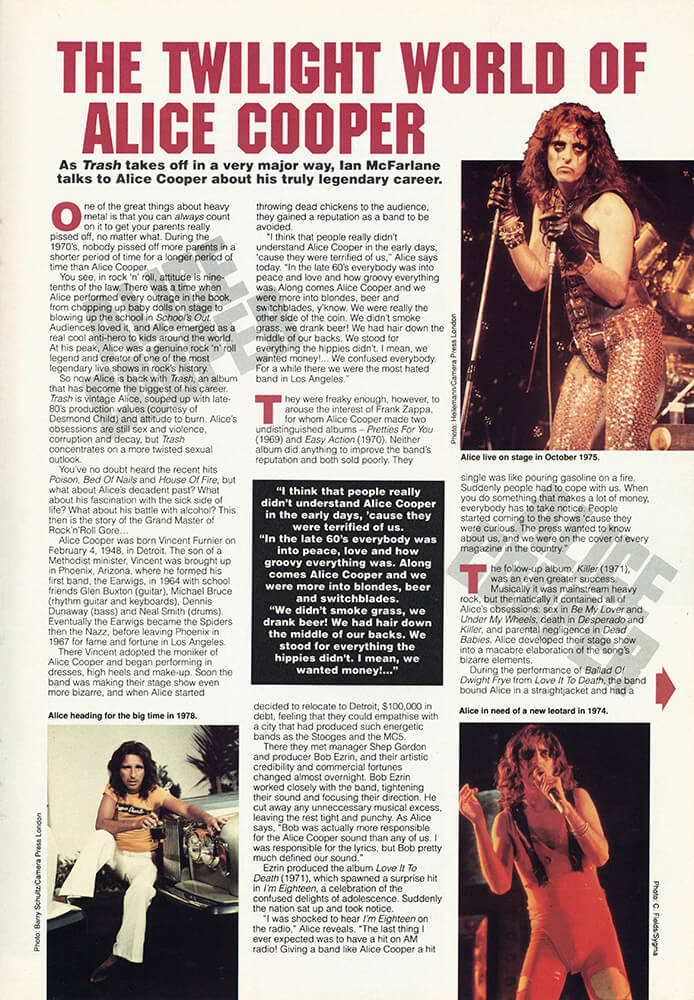
One of the great things about heavy metal is that you can always count on it to get your parents pissed off, no matter what. During the 1970's, nobody pissed off more parents in a shorter period of time for a longer period of time than Alice Cooper.
You see, in rock 'n' roll, attitude is nine-tenths of the law. There was a time when Alice performed every outrage in the book, from chopping up baby dolls on stage to blowing up the school in School's Out. Audiences loved it, and Alice emerged as a real cool anti-hero to kids around the world. At his peak, Alice was a genuine rock 'n' roll legend and creator of one of the most legendary live shows in rock's history.
So now Alice is back with Trash, an album that has become the biggest of his career. Trash is vintage Alice, souped up with late-80's production values (courtesy of Desmond Child) and attitude to burn. Alice's obsessions are still sex and violence, corruption and decay, but Trash concentrates on a more twisted sexual outlook.
You've no doubt heard the recent hits Poison, Bed Of Nails and House Of Fire, but what about Alice's decadent past? What about his fascination with the sick side of life? What about his battle with alcohol? This then is the story of the Grand Master of Rock 'n' Roll Gore...
Alice Cooper was born Vincent Furnier on February 4, 1948, in Detroit. The son of a Methodist minister, Vincent was brought up in Phoenix, Arizona, where he formed his first band, the Earwigs, in 1964 with school friends Glen Buxton (guitar), Michael Bruce (rhythm guitar and keyboards), Dennis Dunaway (bass) and Neal Smith (drums). Eventually the Earwigs became the Spiders then the Nazz, before leaving Phoenix in 1967 for fame and fortune in Los Angeles.
There Vincent adopted the moniker of Alice Cooper and began performing in dresses, high heels and make-up. Soon the band was making their stage show even more bizarre, and when Alice started throwing dead chickens to the audience, they gained a reputation as a band to be avoided.
"I think that people really didn't understand Alice Cooper in the early days, 'cause they were terrified of us," Alice says today. "In the late 60's everybody was into peace and love and how groovy everything was. Along comes Alice Cooper and we were more into blondes, beer and switchblades, y'know. We were really the other side of the coin. We didn't smoke grass, we drank beer! We had hair down the middle of our backs. We stood for everything the hippies didn't. I mean, we wanted money!... We confused everybody. For a while there we were the most hated band in Los Angeles."
They were freaky enough, however, to arouse the interest of Frank Zappa, for whom Alice Cooper made two undistinguished albums — Pretties For You (1969) and Easy Action (1970). Neither album did anything to improve the band's reputation and both sold poorly. They decided to relocate to Detroit, $100,000 in debt, feeling that they could empathise with a city that had produced such energetic bands as the Stooges and the MC5.
There they met manager Shep Gordon and producer Bob Ezrin, and their artistic credibility and commercial fortunes changed almost overnight. Bob Ezrin worked closely with the band, tightening their sound and focusing their direction. He cut away any unneccessary musical excess, leaving the rest tight and punchy. As Alice says, "Bob was actually more responsible for the Alice Cooper sound than any of us. I was responsible for the lyrics, but Bob pretty much defined our sound."
Ezrin produced the album Love It To Death (1971 ), which spawned a surprise hit in I'm Eighteen, a celebration of the confused delights of adolescence. Suddenly the nation sat up and took notice.
"I was shocked to hear I'm Eighteen on the radio," Alice reveals. "The last thing I ever expected was to have a hit on AM radio! Giving a band like Alice Cooper a hit single was like pouring gasoline on a fire. Suddenly people had to cope with us. When you do something that makes a lot of money, everybody has to take notice. People started coming to the shows 'cause they were curious. The press wanted to know about us, and we were on the cover of every magazine in the country."
The follow-up album, Killer (1971), was an even greater success. Musically it was mainstream heavy rock, but thematically it contained all of Alice's obsessions: sex in Be My Lover and Under My Wheels, death in Desperado and Killer, and parental negligence in Dead Babies. Alice developed their stage show into a macabre elaboration of the song's bizarre elements.
During the performance of Ballad Of Dwight Frye from Love It To Death, the band bound Alice in a straightjacket and had a nurse lead him offstage. Later on, Alice draped a six-foot Boa Constrictor around his torso, fought with members of the band and, during Killer, chopped up baby dolls with a real axe. For the finale, Alice was strung up on gallows or tied to an electric chair — though he always bounced back for an encore, dressed in top hat and tails.
According to Alice, the message was a moralistic one. This Alice Cooper character he had created was a dangerous villain, and his songs merely reflected the sick side of life. After he had performed his gruesome axe murders on stage, he had to be punished for them.
The aim was to shock and it did. It was the title track of Alice Cooper's next album, School's Out ( 1972), that caused a public outcry with its anarchic refrain and rejection of childhood innocence. As a single, it became a huge hit in the U.S., U.K. and Australia, and the band undertook a successful British tour.
School's Out marked the high point in Alice's career to that time, but it was the follow-up album and tour, Billion Dollar Babies (1973), that remained their best for many years. The album featured lush production and extravagant packaging, and contained such tracks as Elected (another huge hit), No More Mister Nice Guy (recently covered by Megadeth for the Wes Craven film Shocker), and a tasteless hymn to necrophilia, I Love The Dead.
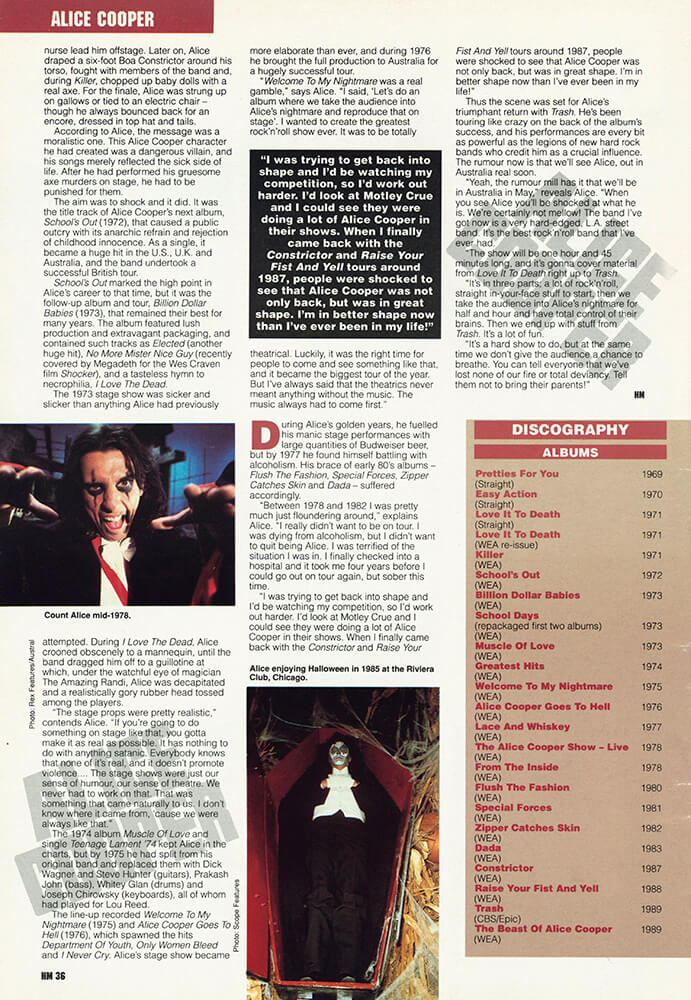
The 1973 stage show was sicker and slicker than anything Alice had previously attempted. During I Love The Dead, Alice crooned obscenely to a mannequin, until the band dragged him off to a guillotine at which, under the watchful eye of magician The Amazing Randi, Alice was decapitated and a realistically gory rubber head tossed among the players.
"The stage props were pretty realistic," contends Alice. "If you're going to do something on stage like that, you gotta make it as real as possible. It has nothing to do with anything satanic. Everybody knows that none of it's real, and it doesn't promote violence... The stage shows were just our sense of humour, our sense of theatre. We never had to work on that. That was something that came naturally to us. I don't know where it came from, 'cause we were always like that."
The 1974 album Muscle Of Love and single Teenage Lament '74 kept Alice in the charts, but by 1975 he had split from his original band and replaced them with Dick Wagner and Steve Hunter (guitars), Prakash John (bass), Whitey Gian (drums) and Joseph Chirowsky (keyboards), all of whom had played for Lou Reed.
The line-up recorded Welcome To My Nightmare (1975) and Alice Cooper Goes To Hell (1976), which spawned the hits Department Of Youth, Only Women Bleed and I Never Cry. Alice's stage show became more elaborate than ever, and during 1976 he brought the full production to Australia for a hugely successful tour.
"Welcome To My Nightmare was a real gamble," says Alice. "I said, 'Let's do an album where we take the audience into Alice's nightmare and reproduce that on stage'. I wanted to create the greatest rock'n'roll show ever. It was to be totally theatrical. Luckily, it was the right time for people to come and see something like that, and it became the biggest tour of the year. But I've always said that the theatrics never meant anything without the music. The music always had to come first."
During Alice's golden years, he fuelled his manic stage performances with large quantities of Budweiser Beer but by 1977 he found himself battling with alcoholism. His brace of early 80's albums — Flush The Fashion, Special Forces, Zipper Catches Skin and Dada — suffered accordingly.
"Between 1978 and 1982 I was pretty much just floundering around," explains Alice. "I really didn't want to be on tour. I was dying from alcoholism, but I didn't want to quit being Alice. I was terrified of the situation I was in. I finally checked into a hospital and it took me four years before I could go out on tour again, but sober this time.
"I was trying to get back into shape and I'd be watching my competition, so I'd work out harder. I'd look at Motley Crue and I could see they were doing a lot of Alice Cooper in their shows. When I finally came back with the Constrictor and Raise Your Fist And Yell tours around 1987, people were shocked to see that Alice Cooper was not only back, but was in great shape. I'm in better shape now than I've ever been in my life!"
Thus the scene was set for Alice's triumphant return with Trash. He's been touring like crazy on the back of the album's success, and his performances are every bit as powerful as the legions of new hard rock bands who credit him as a crucial influence. The rumour now is that we'll see Alice, out in Australia real soon.
"Yeah, the rumour mill has it that we'll be in Australia in May," reveals Alice. "When you see Alice you'll be shocked at what he is. We're certainly not mellow! The band I've got now is a very hard-edged, L.A. street band. It's the best rock'n'roll band that I've ever had.
"The show will be one hour and 45 minutes long, and it's gonna cover material from Love It To Death right up to Trash.
"It's in three parts; a lot of rock'n'roll, straight in-your-face stuff to start, then we take the audience into Alice's nightmare for half and hour and have total control of their brains. Then we end up with stuff from Trash. It's a lot of fun.
"It's a hard show to do, but at the same time we don't give the audience a chance to breathe. You can tell everyone that we've lost none of our fire or total deviancy. Tell them not to bring their parents!"
(Originally published in Issue #14 of Australia's Hot Metal magazine, April 1990)
Images