
Article Database
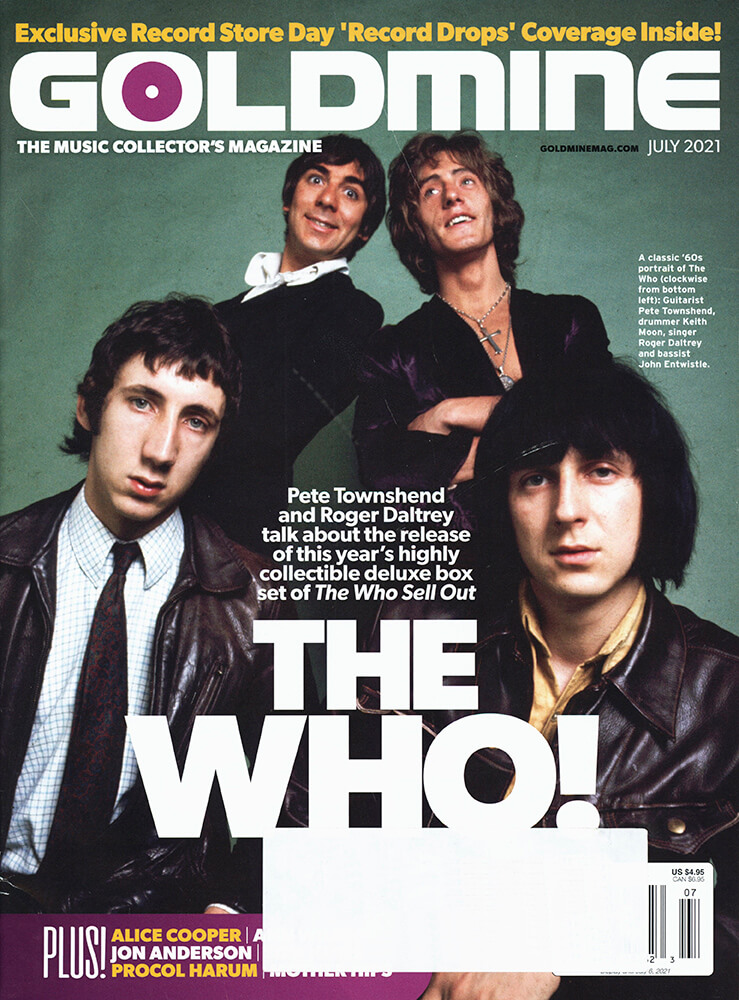
Goldmine
July 2021
The Return Of Alice Cooper
Author: Elliot Stephen Cohen
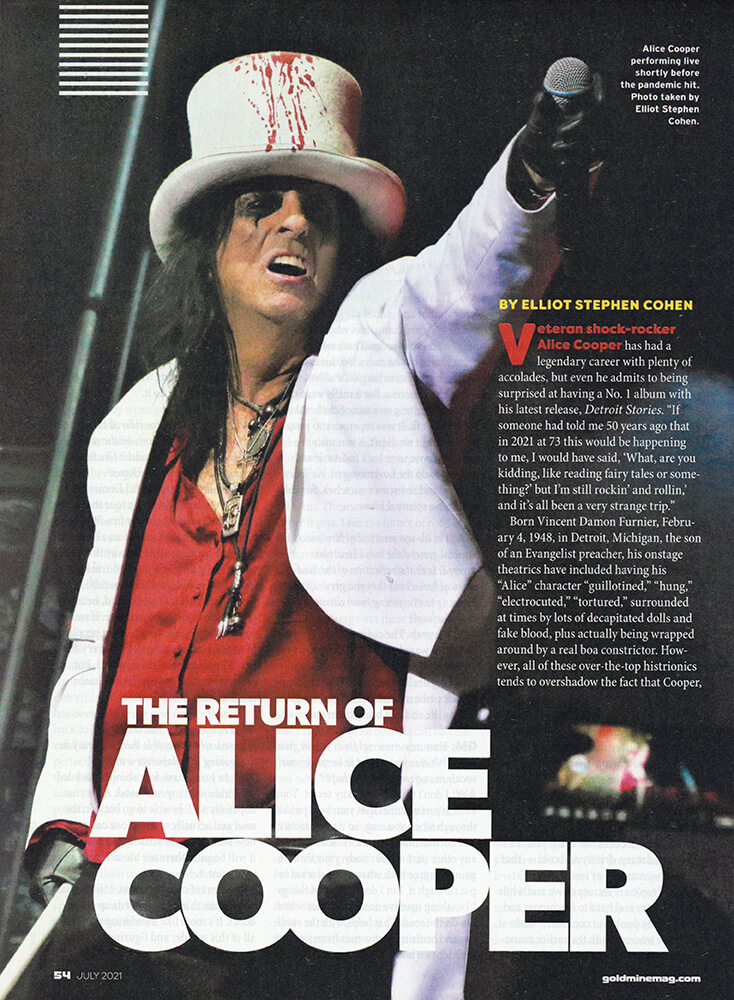
Veteran shock-rocker Alice Cooper has had a legendary career with plenty of accolades, but even he admits to being surprised at having a No. 1 album with his latest release, Detroit Stories. "If someone had told me 50 years ago that in 2021 at 73 this would be happening to me, I would have said, 'What, are you kidding me, like reading fairy tales or something?' but I'm still rockin' and rollin', and it's all been a very strange trip."
Born Vincent Damon Furnier, February 4, 1948, in Detroit, Michigan, the son of an Evangelist preacher, his onstage theatrics have included having his "Alice" character "guillotined," "hung," "electrocuted," "tortured," surrounded at times by lots of decapitated dolls and fake blood, plus actually being wrapped around by a real boa constrictor. However, all of these over-the-top histrionics tend to overshadow the fact that Cooper, besides being a highly entertaining performer, is actually also a great rock singer.
His original late-'60s band adopted the androgynous-sounding Alice Cooper moniker after discovering that Nazz was already used by Todd Rundgren's group. The original group, which included lead guitarist Glen Buxton, rhythm guitarist Michael Bruce, bass player Dennis Dunaway and drummer Neal Smith, were inducted into the Rock and Roll Hall of Fame in 2011.
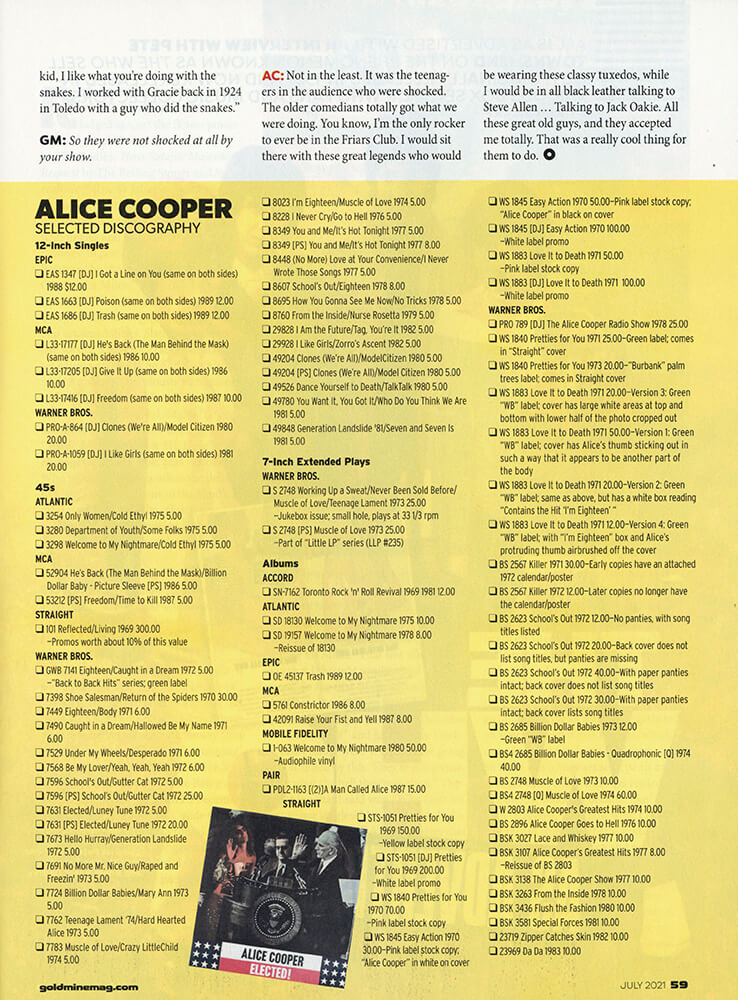
In 1968, the band's manager Shep Gordon arranged an audition with famed music impresario Frank Zappa, who was impressed enough to sign them to a three-album deal for his Straight Records label. While those three albums failed to attract national recognition, the group's popularity grew quickly after being signed by the much larger Warner Bros. conglomerate. They soon struck gold with their first Top 10 hit, "School's Out," and most successful album, Billion Dollar Babies. However, by 1975, with the release of Welcome to My Nightmare, the band was no more. In a savvy move to avoid possible future legal problems that now plague so many classic rock bands fighting over name ownership, Furnier not only took possession of the group's name, he also legally had his birth name changed to Alice Cooper, for a new solo career.
Within two years, though, the pressures of his newfound success led to a severe drinking habit, reportedly imbibing nearly two cases of beer and a bottle of whiskey on a daily basis, which led to a self-imposed sanatorium hospitalization. Just six years later, he was again hospitalized, this time with a badly damaged liver. Since then Cooper says he's avoided any type of alcohol or drugs. His regular golfing routine has helped him stay fit into his eighth decade, and his highly acclaimed internationally syndicated radio show, Nights With Alice Cooper, also keeps him very busy.
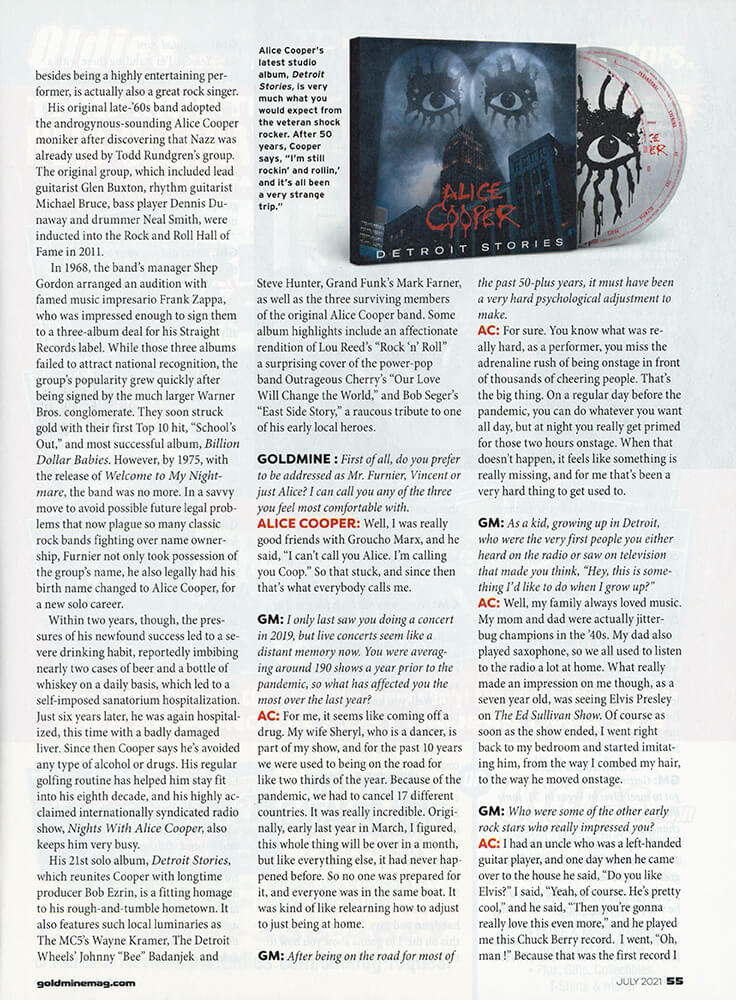
His 21st solo album, Detroit Stories, which reunites Cooper with longtime producer Bob Ezrin, is a fitting homage to his rough-and-tumble hometown. It also features such local luminaries as The MCS's Wayne Kramer, The Detroit Wheels' Johnny "Bee" Badanjek and Steve Hunter, Grand Funk's Mark Farner, as well as the three surviving members of the original Alice Cooper band. Some album highlights include an affectionate rendition of Lou Reed's "Rock 'n' Roll" a surprising cover of the power-pop band Outrageous Cherry's "Our Love Will Change the World," and Bob Seger's "East Side Story," a raucous tribute to one of his early local heroes.
GOLDMINE: First of all, do you prefer to be addressed as Mr. Furnier, Vincent or just Alice? I can call you any of the three you feel most comfortable with.
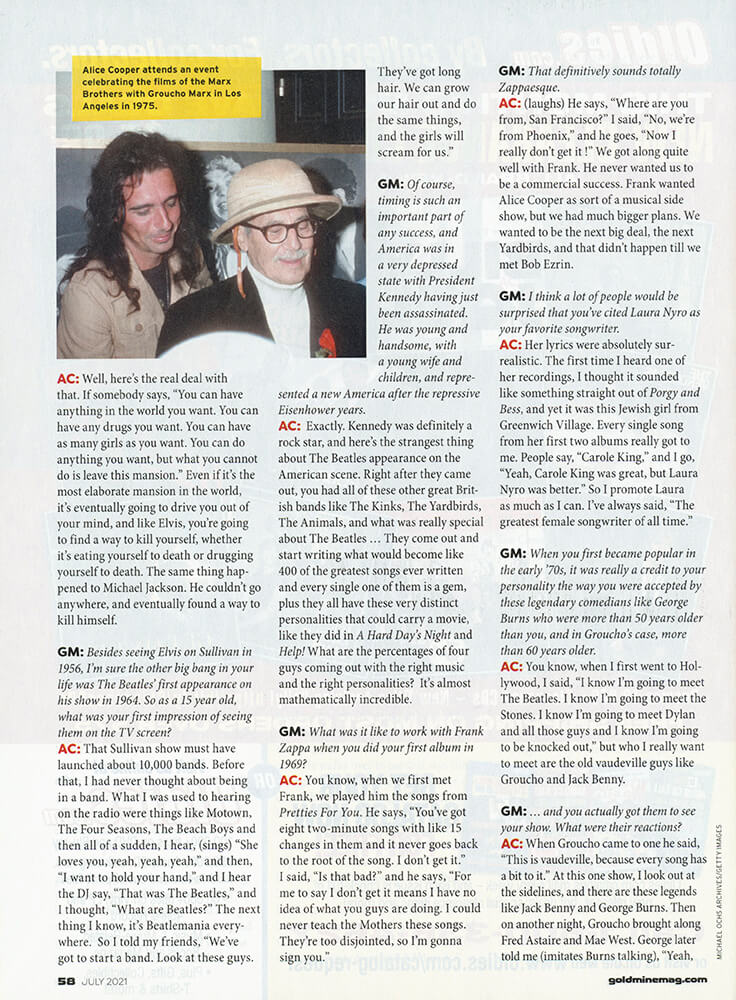
ALICE COOPER: Well, I was really good friends with Groucho Marx, and he said, "I can't call you Alice. I'm calling you Coop." So that stuck, and since then that's what everybody calls me.
GM: I only last saw you doing a concert in 2019, but live concerts seem like a distant memory now. You were averaging around 190 shows a year prior to the pandemic, so what has affected you the most over the last year?
AC: For me, it seems like coming off a drug. My wife Sheryl, who is a dancer, is part of my show, and for the past 10 years we were used to being on the road for like two thirds of the year. Because of the pandemic, we had to cancel 17 different countries. It was really incredible. Originally, early last year in March, I figured, this whole thing will be over in a month, but like everything else, it had never happened before. So no one was prepared for it, and everyone was in the same boat. It was kind of like relearning how to adjust to just being at home.
GM: After being on the road for most of the past SO-plus years, it must have been a very hard psychological adjustment to make.
AC: For sure. You know what was really hard, as a performer, you miss the adrenaline rush of being onstage in front of thousands of cheering people. That's the big thing. On a regular day before the pandemic, you can do whatever you want all day, but at night you really get primed for those two hours onstage. When that doesn't happen, it feels like something is really missing, and for me that's been a very hard thing to get used to.
GM: As a kid, growing up in Detroit, who were the very first people you either heard on the radio or saw on television that made you think, "Hey, this is something I'd like to do when I grow up?"
AC: Well, my family always loved music. My mom and dad were actually jitterbug champions in the '40s. My dad also played saxophone, so we all used to listen to the radio a lot at home. What really made an impression on me though, as a seven year old, was seeing Elvis Presley on The Ed Sullivan Show. Of course as soon as the show ended, I went right back to my bedroom and started imitating him, from the way I combed my hair, to the way he moved onstage.
GM: Who were some of the other early rock stars who really impressed you?
AC: I had an uncle who was a left-handed guitar player, and one day when he came over to the house he said, "Do you like Elvis?" I said, "Yeah, of course. He's pretty cool," and he said, "Then you're gonna really love this even more," and he played me this Chuck Berry record. I went, "Oh, man!" Because that was the first record I ever heard where the guitar was leading everything. That loud electric guitar of Chuck's was leading the song, and immediately I was hooked on that, and also came to realize that Chuck Berry was the greatest lyricist of all time.
GM: Many musicians have named Chuck Berry the greatest all-round talent rock and roll has ever produced.
AC: Well, if Chuck couldn't think of a word, he would just make one up, like "motorvatin' over the hill" in "Maybellene," or "don't give me no botheration,"' (in "Too Much Monkey Business") or the "coolerator" was full of beer (in "You Never Can Tell").
GM: Getting back to Elvis, you actually got to meet Elvis in Vegas in '71, something very few rock stars ever had to the chance to do. That must have been a very surreal experience, to say the least.
AC: Definitely! (laughs) It was such a great experience. Elvis was up in his big penthouse at the Hilton Hotel, where he was performing. I was invited along with Liza Minnelli, Chubby Checker and (porn star) Linda Lovelace. We were the four that were chosen to meet Elvis that night. Now, there's a big special elevator that goes to the penthouse, and before any of us gets up to meet Elvis, all of us are checked very carefully for guns, which was kind of silly because when we got up there, there were guns everywhere.
GM: People who met Elvis have said he was so incredibly good looking and had such charisma that even if he had remained a truck driver, when he walked into a room, everyone, whether they were female or male, would have stared in his direction.
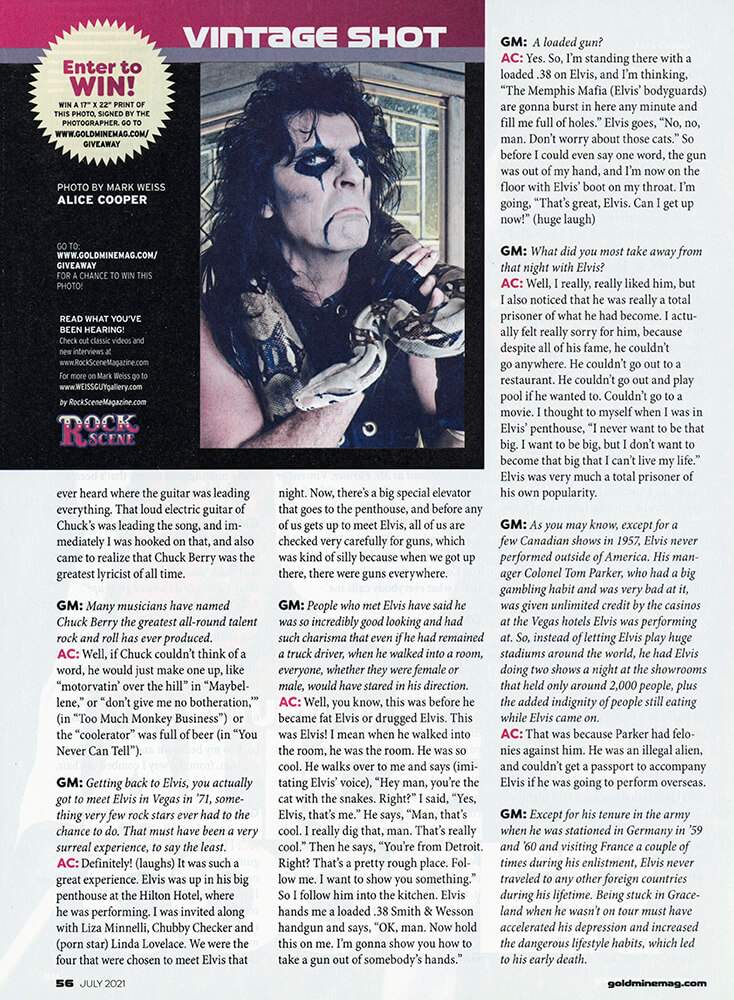
AC: Well, you know, this was before he became fat Elvis or drugged Elvis. This was Elvis! I mean when he walked into the room, he was the room. He was so cool. He walks over to me and says (imitating Elvis' voice), "Hey man, you're the cat with the snakes. Right?" I said, "Yes, Elvis, that's me." He says, "Man, that's cool. I really dig that, man. That's really cool." Then he says, "You're from Detroit. Right? That's a pretty rough place. Follow me. I want to show you something." So I follow him into the kitchen. Elvis hands me a loaded .38 Smith & Wesson handgun and says, "OK, man. Now hold this on me. I'm gonna show you how to take a gun out of somebody's hands."
GM: A loaded gun?
AC: Yes. So, I'm standing there with a loaded .38 on Elvis, and I'm thinking, "The Memphis Mafia (Elvis' bodyguards) are gonna burst in here any minute and fill me full of holes." Elvis goes, "No, no, man. Don't worry about those cats." So before I could even say one word, the gun was out of my hand, and I'm now on the floor with Elvis' boot on my throat. I'm going, "That's great, Elvis. Can I get up now!" (huge laugh)
GM: What did you most take away from that night with Elvis?
AC: Well, I really, really liked him, but I also noticed that he was really a total prisoner of what he had become. I actually felt really sorry for him, because despite all of his fame, he couldn't go anywhere. He couldn't go out to a restaurant. He couldn't go out and play pool if he wanted to. Couldn't go to a movie. I thought to myself when I was in Elvis' penthouse, "I never want to be that big. I want to be big, but I don't want to become that big that I can't live my life." Elvis was very much a total prisoner of his own popularity.
GM: As you may know, except for a few Canadian shows in 1957, Elvis never performed outside of America. His manager Colonel Tom Parker, who had a big gambling habit and was very bad at it, was given unlimited credit by the casinos at the Vegas hotels Elvis was performing at. So, instead of letting Elvis play huge stadiums around the world, he had Elvis doing two shows a night at the showrooms that held only around 2,000 people, plus the added indignity of people still eating while Elvis came on.
AC: That was because Parker had felonies against him. He was an illegal alien, and couldn't get a passport to accompany Elvis if he was going to perform overseas.
GM: Except for his tenure in the army when he was stationed in Germany in '59 and '60 and visiting France a couple of times during his enlistment, Elvis never traveled to any other foreign countries during his lifetime. Being stuck in Graceland when he wasn't on tour must have accelerated his depression and increased the dangerous lifestyle habits, which led to his early death.
AC: Well, here's the real deal with that. If somebody says, "You can have anything in the world you want. You can have any drugs you want. You can have as many girls as you want. You can do anything you want, but what you cannot do is leave this mansion." Even if it's the most elaborate mansion in the world, it's eventually going to drive you out of your mind, and like Elvis, you're going to find a way to kill yourself, whether it's eating yourself to death or drugging yourself to death. The same thing happened to Michael Jackson. He couldn't go anywhere, and eventually found a way to kill himself.
GM: Besides seeing Elvis on Sullivan in 1956, I'm sure the other big bang in your life was The Beatles' first appearance on his show in 1964. So as a 15 year old, what was your first impression of seeing them on the TV screen?
AC: That Sullivan show must have launched about 10,000 bands. Before that, I had never thought about being in a band. What I was used to hearing on the radio were things like Motown, The Four Seasons, The Beach Boys and then all of a sudden, I hear, (sings) "She loves you, yeah, yeah, yeah," and then, "I want to hold your hand," and I hear the DJ say, "That was The Beatles," and I thought, "What are Beatles?" The next thing I know, it's Beatlemania everywhere. So I told my friends, "We've got to start a band. Look at these guys. They've got long hair. We can grow our hair out and do the same things, and the girls will scream for us."
GM: Of course, timing is such an important part of any success, and America was in a very depressed state with President Kennedy having just been assassinated. He was young and handsome, with a young wife and children, and represented a new America after the repressive Eisenhower years.
AC: Exactly. Kennedy was definitely a rock star, and here's the strangest thing about The Beatles appearance on the American scene. Right after they came out, you had all of these other great British bands like The Kinks, The Yardbirds, The Animals, and what was really special about The Beatles... They come out and start writing what would become like 400 of the greatest songs ever written and every single one of them is a gem, plus they all have these very distinct personalities that could carry a movie, like they did in A Hard Day's Night and Help! What are the percentages of four guys coming out with the right music and the right personalities? It's almost mathematically incredible.
GM: What was it like to work with Frank Zappa when you did your first album in 1969?
AC: You know, when we first met Frank, we played him the songs from Pretties For You. He says, "You've got eight two-minute songs with like 15 changes in them and it never goes back to the root of the song. I don't get it." I said, "Is that bad?" and he says, "For me to say I don't get it means I have no idea of what you guys are doing. I could never teach the Mothers these songs. They're too disjointed, so I'm gonna sign you."
GM: That definitively sounds totally Zappaesque.
AC: (laughs) He says, "Where are you from, San Francisco?" I said, "No, we're from Phoenix," and he goes, "Now I really don't get it!" We got along quite well with Frank. He never wanted us to be a commercial success. Frank wanted Alice Cooper as sort of a musical side show, but we had much bigger plans. We wanted to be the next big deal, the next Yardbirds, and that didn't happen till we met Bob Ezrin.
GM: I think a lot of people would be surprised that you've cited Laura Nyro as your favorite songwriter.
AC: Her lyrics were absolutely surrealistic. The first time I heard one of her recordings, I thought it sounded like something straight out of Porgy and Bess, and yet it was this Jewish girl from Greenwich Village. Every single song from her first two albums really got to me. People say, "Carole King," and I go, "Yeah, Carole King was great, but Laura Nyro was better." So I promote Laura as much as I can. I've always said, "The greatest female songwriter of all time."
GM: When you first became popular in the early '70s, it was really a credit to your personality the way you were accepted by these legendary comedians like George Burns who were more than 50 years older than you, and in Groucho's case, more than 60 years older.
AC: You know, when I first went to Hollywood, I said, "I know I'm going to meet The Beatles. I know I'm going to meet the Stones. I know I'm going to meet Dylan and all those guys and I know I'm going to be knocked out," but who I really want to meet are the old vaudeville guys like Groucho and Jack Benny.
GM: ...and you actually got them to see your show. What were their reactions?
AC: When Groucho came to one he said, "This is vaudeville, because every song has a bit to it." At this one show, I look out at the sidelines, and there are these legends like Jack Benny and George Burns. Then on another night, Groucho brought along Fred Astaire and Mae West. George later told me (imitates Burns talking), "Yeah, kid, I like what you're doing with the snakes. I worked with Gracie back in 1924 in Toledo with a guy who did the snakes."
GM: So they were not shocked at all by your show.
AC: Not in the least. It was the teenagers in the audience who were shocked. The older comedians totally got what we were doing. You know, I'm the only rocker to ever be in the Friars Club. I would sit there with these great legends who would be wearing these classy tuxedos, while I would be in all black leather talking to Steve Allen... Talking to Jack Oakie. All these great old guys, and they accepted me totally. That was a really cool thing for them to do.
(Originally published in Goldmine magazine, Issue 931; Vol. 47, No. 7)
Images